When does a B&B or holiday home need a PMS?
The trigger is not a fixed number of rooms. It is the point where manual coordination becomes a recurring source of duplicated work, missed action or uncertainty.
- Reservations arrive from multiple OTAs or from a direct website.
- Availability and rates are updated in more than one place.
- Guests repeat questions about arrival, parking, Wi-Fi and rules.
- Another person helps with reception, cleaning or maintenance.
- Guest details and reporting deadlines are difficult to monitor.
- Direct bookings require a reliable calendar and payment process.
- The operator cannot see what is missing for today without checking several tools.
What small accommodation teams actually need.
The priority is a small number of reliable workflows. Buyers should confirm the manual work behind every “automatic” feature.
Readable arrivals, departures, rooms or units, blocks, modifications and conflicts.
Documented API or iCal depth for the channels the business actually uses.
Conversations connected to the correct booking, room or property and useful history.
Collect required details before arrival and show what still needs verification.
Keep national and regional steps separate, with visible errors, outcomes and evidence.
Create simple, mobile tasks and reveal when a room or unit is ready or blocked.
Provide one maintained link for arrival, property use, safety and checkout.
Use the same live availability, restrictions, policies and payment conditions.
Clarify what is collected, reconciled or issued by the PMS and what needs another service.
Offer accessible help and a way to recover reservations, guest records and documents.
Simple software is not the same as limited software.
A small team benefits from progressive complexity: the common daily work stays obvious, while exceptions and detailed controls are available when needed.
Simple
Today’s work, guest context and missing actions are understandable without specialist training.
Complete
Errors, permissions, channel depth, receipts and export paths are not removed to make the interface look clean.
Appropriate
Automation supports a repeated task only after the source data and fallback process are clear.
Choose by operating model, not only by size.
Different forms of small hospitality create different priorities. The demo should follow the actual accommodation model.
Fast arrival view, guest communication, room status and reporting may matter more than complex owner accounting.
Remote check-in, guest guide, cleaning and national or regional compliance become central.
Multi-property calendar, staff assignment, permissions and exception control are more important.
Booking engine, availability, payments, policies and guest relationship need one consistent path.
Checklist for evaluating a B&B or holiday-home PMS.
Ask for a complete demonstration from a new reservation to checkout and reporting, including one modification or failed step.
Can you immediately see arrivals, departures, unpaid items, missing guest data and unready units?
Which operations are available for each priority OTA, and which remain in the extranet?
Does the product generate files or submit directly, and how are errors and receipts handled?
Can a small team complete the important work without using the full desktop administration?
Does the website use the same inventory and make total price, policies and payment state clear?
Which modules, channels, rooms, users, onboarding and payment services add fees?
Can future reservations and property data be imported, checked and later exported?
What PMSLY is designing for small operators in Italy.
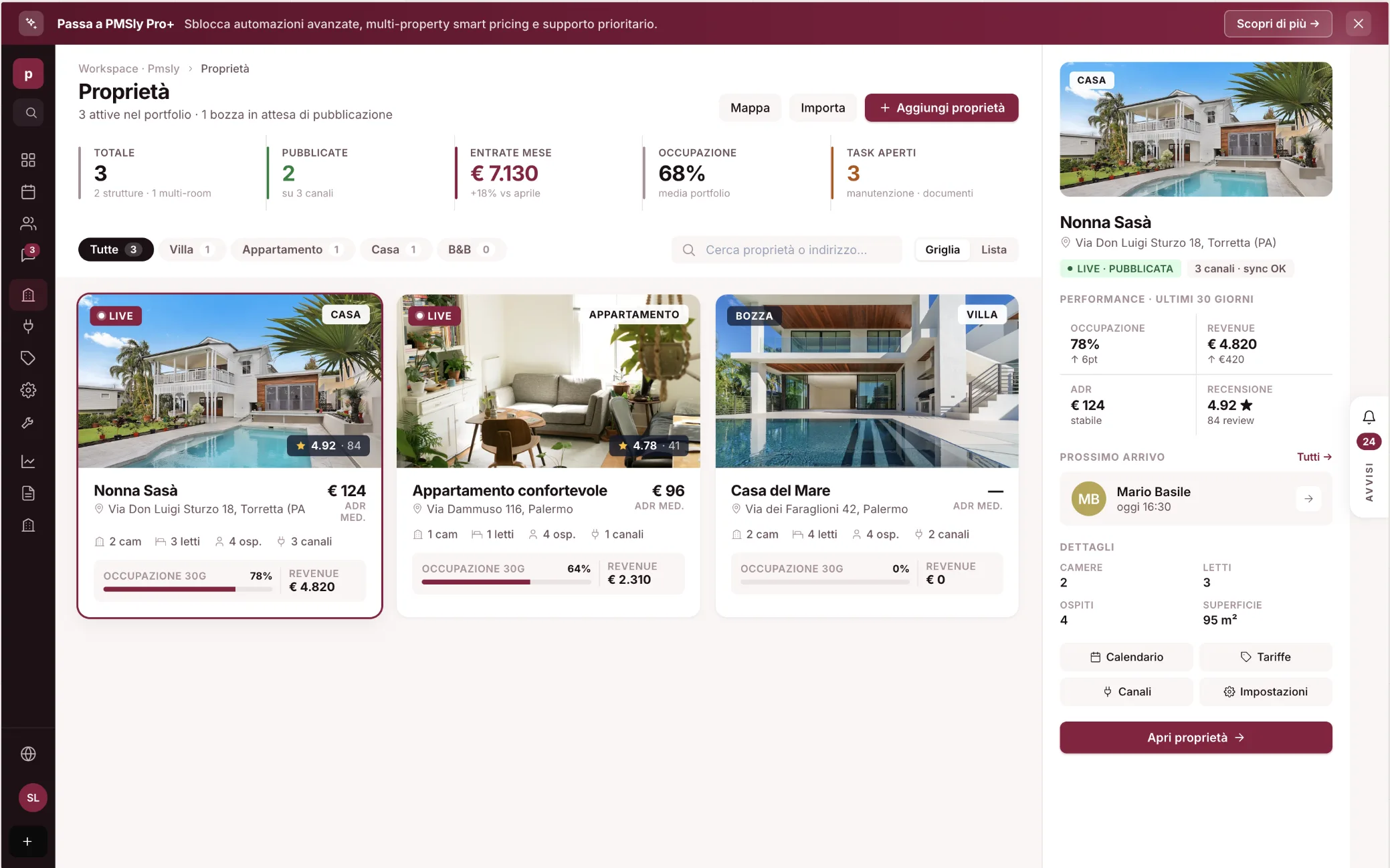
PMSLY is in pre-launch. The direction is to support the whole stay — property information, reservations, conversations, tasks, guest guide and compliance states — without making small teams operate a fragmented enterprise stack. Channel connections, payments and official submissions still require validation.
Daily clarity
A focused view of what arrives, departs, waits for data or blocks readiness.
Shared property context
Rules and instructions can support the inbox, guide and field team without repeated entry.
Honest boundaries
A feature under development is not labelled as live until the integration and operating evidence exist.
Frequently asked questions
Does a small B&B really need a PMS?
Not always. It becomes useful when several channels, collaborators, reporting duties or repeated guest workflows create errors and duplicate work.
What is the difference between B&B software and a hotel PMS?
The core concepts overlap, but small accommodation often prioritizes a lighter daily workflow, remote operations, direct support and clear local compliance.
Can one-property operators benefit?
Yes when the property has high turnover, several sales channels, remote check-in or multiple collaborators. The decision should follow workload rather than unit count.
Should Alloggiati Web be built into the PMS?
It can reduce duplicate work, but verify whether the product only generates a file or performs a validated direct submission and handles outcomes and receipts.
Can it support direct bookings?
A suitable PMS may include or connect a booking engine that shares the same inventory and clearly manages rates, policies and payments.
Is PMSLY already available for B&Bs?
No. PMSLY is in pre-launch and is validating the workflows and integrations required by small Italian accommodation businesses.