
What does a vacation-rental channel manager do?
It maintains a common inventory across supported sales channels. The depth depends on the connection and the commercial agreement between the software provider and each platform.
May exchange availability, rates, restrictions, reservations, content or messages, but the supported scope differs by platform and provider.
Primarily exchanges calendar events and blocks. It is not equivalent to full rate, restriction, content or message management.
Should use the same live inventory so a direct reservation blocks the relevant unit on every connected channel.
Passes the reservation into guest, property, staff, payment and compliance workflows beyond distribution.
Which data should a channel manager synchronize?
Availability is the baseline. A serious comparison records the supported direction and limitations for every data family.
Inventory, minimum unit count, manual blocks and the effect of modifications or cancellations.
Base rates, derived rates, occupancy pricing, fees and taxes where the channel supports them.
Minimum stay, closed-to-arrival, closed-to-departure, stop-sell and advance-booking rules.
Guest, dates, price, source, status, special requests and channel-specific details.
Descriptions, photos, amenities and policies only where content APIs and account permissions allow.
Often channel-specific; verify what is configured centrally and what remains in the OTA extranet.
Do not assume an inventory connection also includes a unified inbox or review workflow.
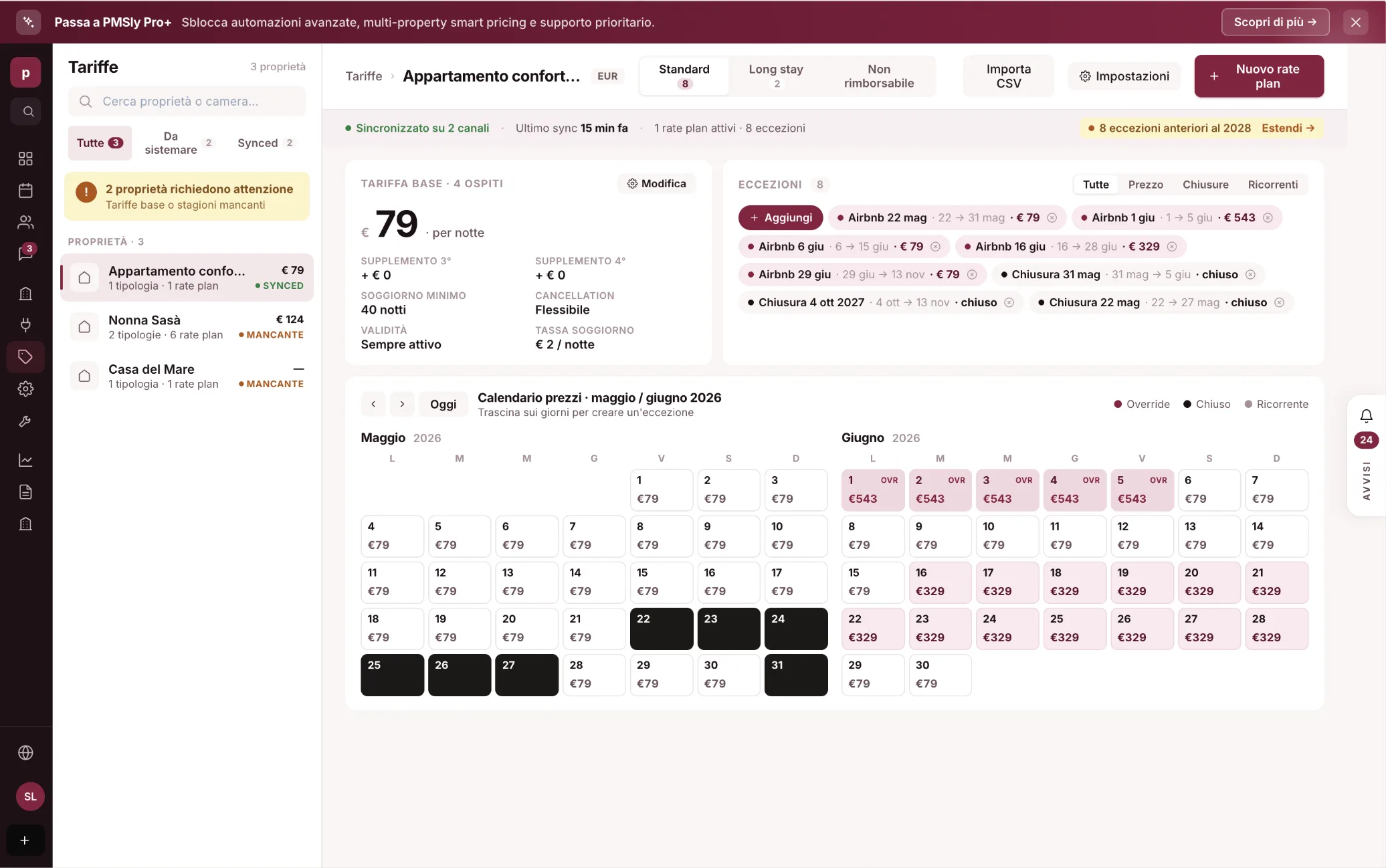
What to verify before choosing a channel manager.
Test the channels, property types and rate plans you actually operate. A long logo list is less useful than documented depth on your primary channels.
For every priority channel, is it API, iCal or another mechanism?
Which data can be imported, edited and pushed back to that specific channel?
How are property, unit, room type, rate plan and occupancy linked and validated?
What latency applies, and which operations are immediate, queued or dependent on the OTA?
Can the team see failed updates, rejected restrictions and disconnected credentials?
How do cancellations, date changes, guest changes and manual moves affect inventory?
Does it use the same inventory, restrictions and payment conditions?
Who handles initial mapping, channel escalation and recovery from a broken connection?
Are costs based on units, bookings, channels, revenue, payment processing or separate modules?
Can reservations, rates and property mappings be exported when changing provider?
Why a channel manager cannot honestly promise zero overbookings.
Good connectivity can reduce risk substantially, but inventory still moves through external systems, mapping rules and human actions. Buyers should evaluate prevention and recovery rather than an absolute slogan.
- An iCal calendar may update less deeply or differently from an API connection.
- A property or rate plan can be mapped to the wrong channel listing.
- Credentials expire or an OTA rejects an update while the PMS still shows the previous state.
- Manual blocks, reservation moves and same-minute bookings create edge cases.
- The team needs an alert, audit trail and recovery process when synchronization fails.
Where channel management ends and PMS operations begin.
Distribution answers where the property can be sold and whether inventory is consistent. The PMS must coordinate what happens after a reservation exists.
Guest workflow
Messages, identity data, check-in, access and in-stay support.
Field operations
Cleaning, maintenance, inspections and readiness linked to arrivals and departures.
Italian compliance
Alloggiati Web and regional reporting states, errors, evidence and deadlines.
How PMSLY is evaluating channel connectivity.
PMSLY is in pre-launch. The product direction is for a reservation to enter the shared calendar and activate guest and staff workflows. Channel priorities, connection depth, mapping and error handling still require technical validation; PMSLY does not currently claim a fixed OTA count, complete two-way synchronization or zero overbookings.
Validate the connection
Document the supported operation and failure states for each channel.
Attach operating context
Connect property, stay, guest and source once the reservation is accepted.
Trigger the next work
Use arrival and departure context for communications and field operations only after the data is reliable.
Primary sources for checking OTA connectivity.
Connectivity changes over time. Verify current partnership requirements and supported APIs through the platforms’ own documentation.
Frequently asked questions
Are a channel manager and PMS the same thing?
No. The channel manager focuses on distribution, availability, rates and reservations. The PMS also coordinates guests, properties, staff, records and operating workflows.
What is the difference between API and iCal?
An API can support structured, channel-specific operations beyond calendar blocks. iCal mainly exchanges calendar events. Exact scope still depends on the provider and platform.
Does a channel manager prevent every overbooking?
It reduces risk but cannot guarantee an absolute result. Mapping, update timing, connection failures, manual actions and channel behavior still matter.
Do I need one for a single portal?
Possibly not. It becomes more important with several channels or a direct-booking strategy sharing the same inventory.
Should I choose the provider with the most channel logos?
Prioritize verified connection depth, reliability and support for the channels that generate your actual bookings.
Which channels does PMSLY already support?
PMSLY is in pre-launch. Channel priorities and integrations are under validation, so no unverified live channel count is stated.